War of the Worlds, Buffalo Style


Above is the Halloween radio adaptation of the War of the Worlds by WKBW in Buffalo.  WKBW originally broadcasted War of the Worlds in 1968 and updated versions throughout the 1970’s.  For myself, it was a Halloween tradition to sit on the front steps, chow down some Halloween candy, and listen to the broadcast.  Although the program would start at 11 PM, I had no worries, as going to a Catholic school, the following morning was All Saints Day and that meant an off day.  It wasn’t only Western New Yorkers who listened to the dramatization of their city being destroyed by Martians, WKBW’s 50,000 watt transmitter would reach as far into the Carolinas once the Sun set.

The 1968 broadcast was an homage to Orson Wells legendary 1938 radio version.  The events were transplanted to the Buffalo region.  In 1968, KB DJ Danny Neaverth opens up the proceedings with a brief introduction.  If you lived in Buffalo during that era, Neaverth’s presence around town seemed ubiquitous.  I can remember watching Neaverth’s noon weather report on WKBW-TV, hearing him at an evening’s Braves game handling the PA duties (two for McAdoo!), then being woken up by Neaverth’s morning show at 6 AM so I could deliver the Courier-Express.

The 1971 version has an updated introduction by Jeff Kaye.  That intro describes various events caused by the 1968 program.  Much like the myth of the 1938 panic, there is some hyperbole involved.  The local newspapers did not report anything unusual the following day except for a few calls made into the station. After the intro,  the broadcast commences with the real newscast from that day.   The first sign of something different is when the news ends with a report from Mt. Palomar Observatory that nuclear sized explosions had been observed on Mars.

The real director of the Mt. Palomar Observatory at the time was Horace Babcock (the broadcast used the name Benjamin Spencer).  In 1953, Babcock first proposed the use of adaptive optics to reduce atmospheric interference for astronomical imaging.  This technique, which utilizes a laser created guide star and deformable mirrors in a telescope’s instrument package, is standard on all modern observatories.  From 1947-93, Mt. Palomar was the largest telescope in the world.

Palomar
The 200-inch Hale Telescope at Mt. Palomar. Photo: Gregory Pijanowski.

Were the nuclear sized explosions on Mars a realistic plot point?  At first glance that might not seem to be the case.  However, keep in mind the Martians made it to Earth in a 24-48 hour period.  Standard chemical rockets take about 8-10 months to complete a voyage to Mars.  What could have propelled the Martians so fast to Earth?  One possibility is nuclear pulse propulsion.  The concept is targeted nuclear explosions are used to provide impulse to spacecraft.  From 1958-63, Project Orion worked on such a propulsion method.  Eventually, the project was shut down by the Nuclear Test Ban Treaty which, obviously, would not apply to invading Martians.

To be fair, the folks at WKBW were concerned with providing programming that had a Halloween ambiance rather than scientific rigor.  And they accomplished this by letting the invasion gradually slide into the program.  It is 20 minutes in until the invasion occupies the show completely.  During that first 20 minutes, listeners are treated to a time capsule of 1968 radio.  The news of the day opens with the Vietnam War and ongoing peace talks (the 1971 version also would open with news from Vietnam, which gives you an idea how well those talks went), Governor Rockefellar breaking ground on the new UB Amherst campus, and various local police busts.  The video removed the music interludes for copyright purposes.  Ads include an 8-track stereo player for $49.95 ($345 today) and shoes for $13.00 ($90 today).  The broadcast takes a dramatic turn with the announcement of a meteor strike on Grand Island.

When that announcement was made, it could be heard throughout the East Coast.  WKBW transmitted with a 50,000 watt tower, the maximum allowed for AM stations.  At night, the range of AM stations expand greatly.  I can remember listening to Sabre-Bruins hockey games and switching back and forth between the Buffalo and Boston broadcasts.  Also, I have tuned into St. Louis’ KMOX in both Buffalo and Houston during the late 70’s when Bob Costas worked there.  While FM has advantages in sound quality over AM, it cannot match the range of AM radio.  And that is due to the nature of the Earth’s ionosphere.

Credit: NASA
Credit: NASA

During the day, ultraviolet and x-ray radiation strike atoms in the upper atmosphere.  This energy ejects electrons, which carry a negative electric charge and forms the various ionosphere layers.  During the day, the lower D and E layers absorb AM radio waves.  Here, the atmosphere is still thick enough so electrons that absorb radio waves collide into air molecules dampening the radio signal.  At night, these lower layers dissipate as there is no sunlight to continue the ionization process.  This leaves radio waves free to reflect off the higher F ionosphere layer.  Here, the atmosphere is tenuous enough so collisions with air molecules are rare.  As a result, AM radio waves are reflected back to the ground enhancing the station’s range.  FM stations do not enjoy this effect as their transmissions are at shorter wavelengths, reducing the collision rate with free ions in the F layer.

For those who heard the original broadcast outside of the Buffalo area, and those listening to it now, here is a map to give you a framework of the events:

WOWmapNominally a sleepy rural area outside of Buffalo, Grand Island has had an interesting history.  Navy Island, adjacent to NW Grand Island, was once considered a potential site for the United Nations.   In 1825, a city on the island called Ararat was proposed as a site for Jewish refugees which never came to fruition.  The Niagara River current, as mentioned in the broadcast, is swift at 3 feet per second and would pull anyone trying to swim across away and over the Falls eventually.  That, of course, happens when the Grand Island bridges are blown in a vain attempt to trap the Martians on the island.

In the Middle
Grand Island Bridges. Credit: amandabanana87 https://flic.kr/p/6PVNVR

The invading Martians make their way downtown to Niagara Square where Irv Weinstein is stationed atop City Hall.  Weinstein started on the radio side of WKBW in the late 50’s, moving over to television in the mid 60’s.  For the next next three decades, Weinstein was the most prominent news figure in the Buffalo area.  Weinstein did refrain from using his trademark “pistol packing punks” (heat ray packing punks?) in the War of the Worlds.  I do not know if there was actually a communications center on top of City Hall back then, but there is an observation platform.  You can see Niagara Falls from up there, and on the clearest of clear days, the CN Tower in Toronto.

cityhall
On top of City Hall. Credit: Gregory Pijanowski

The dramatization concludes where it began, at the WKBW radio station which was at 1430 Main St. a block north of Utica St.  The voice of the last surviving news reporter belongs to Jeff Kaye.  You may find that voice familiar.  During the 1980’s, Jeff Kaye did an admirable job filling the large shoes of John Facenda at NFL Films.  Kaye also produced the War of the Worlds broadcast.  After the Martian’s poison gas takes out the last of the WKBW team, Dan Neaverth returns to  conclude the broadcast noting that H.G. Wells ended the War of the Worlds with the Martians dying off, unable to resist Earth’s microbes.  Wrote Wells:

“But there are no bacteria in Mars, and directly these invaders arrived, directly they drank and fed, our microscopic allies began to work their overthrow.  Already when I watched them (the Martians) they were irrevocably doomed, dying and rotting even as they went to and fro.”

And more than likely, Wells was right about the lack of microbes on Mars, at least on the surface anyway.  Unlike Earth, Mars does not have an ozone layer to block out ultraviolet radiation from the Sun.  Also, Mars lacks a magnetic field.  The Earth’s magnetic field shields life from harmful cosmic rays  Unabated, this radiation is highly harmful to any life on the Martian surface, whether it be microbes or astronauts in the future.  However, the subsurface of Mars may be another story.

One of the key discoveries on Mars the past few decades has been the existence of water below the surface.  On the surface, the lack of atmospheric pressure reduces the boiling point of water so that if it does not freeze it will evaporate quickly.  However, the subsurface of Mars has been found to have significant amounts of water.  Planning for future human exploration of Mars entails utilizing this water for long duration stays on the red planet.  Moreover, where there is water, there may be life.  And this leads to the issue of planetary protection.

NASA has an Office of Planetary Protection.  The goal is to prevent Earth microbes from contaminating Mars and vise versa.  This will become a growing concern for the space program when attempts are made to land humans on Mars or if a Mars sample return mission is sent.  Drilling for water on Mars may expose an ancient subsurface biosphere, and certainly humans could carry Earth microbes to Mars.  While the risks involved are still a matter of scientific debate, Wells was very prescient to include this factor in the War of the Worlds.

Regardless of what we discover about Mars in the next few decades, there was a deeper lesson in the original novel that tends to get lost in modern versions.  The WKBW broadcast capped a night of Halloween themed programming and the primary goal was, as Orson Wells said to conclude his 1938 version, “Dressing up in a sheet, jumping out of a bush and saying, ‘Boo!”.  H.G Wells had intended War of the Worlds as a critique of colonialism.  Wells makes this clear on page three of the novel:

And before we judge of them (Martians) too harshly we must remember what ruthless and utter destruction our own species has wrought, not only upon animals, such as the vanished bison and the dodo, but upon its inferior races.  The Tasmanians, in spite of their human likeness, were entirely swept out of existence in a war of extermination waged by European immigrants, in the space of fifty years.  Are we such apostles of mercy as to complain if the Martians warred in the same spirit?”

At the close of WKBW’s The War of the Worlds, Dan Neaverth asks the audience to think about what they would have done if the invasion was real.  An equally important question to ask is what you would do if you were on the invading side.  Would you join the invasion as the social forces of war coalesced around you, or would you resist the tide, as Bertrand Russell did in World War I:

“I knew it was my business to protest, however futile that protest might be.  I felt that for the honour of human nature those who were not swept off their feet should show that they stood firm.”

Think about it.

What’s Your Sign?

That question, for those of us of a certain age, is associated most often with the garish 70’s singles scene.  For teachers, it represents part of the struggle to educate students new to astronomy to disabuse the relationship between the location of the stars and planets with one’s personal future outlook.  While a teacher might recoil in horror when an assignment is turned in with the heading Astrology 101, a student’s interest in astrology can be used to teach certain astronomy concepts.  It is somewhat similar using science fiction in the classroom.  After all, part of the purpose of education is to enable students to make conceptual leaps from myth to reality.  And to do that, you have to meet the student on level ground.

Astrology is where many of us first learn of the constellations.  There are 88 constellations that divide the celestial sphere in the same manner states divide a nation.  However, astrology focuses on 12 zodiac constellations that lie in the ecliptic and form a background that the Sun and planets move through.  The ecliptic is a narrow path in the sky that the Sun and planets travel from our perspective on Earth.  As the Solar System formed 4.5 billion years ago, the solar nebula flattened causing the planets and Sun to coalesce in the same disk.  Conceptually, it can be difficult to imagine the Sun and planets moving in the same path in the sky as we see them during different times (the Sun during the day and planets at night).  A total solar eclipse does allow us to visualize this.

EclipseThis is a simulation of the total eclipse to occur on April 8, 2024 in Buffalo.  With the Sun’s light blocked by the Moon, you can see how the planets (in this case, Mercury, Venus, Mars, & Saturn) and Sun move along in the same path in the sky.  And this path is called the ecliptic.  You’ll also note two constellations in the ecliptic, Pisces and Aquarius, which correlate to astrological signs.  This illustrates how the Sun lies in constellations just as the planets do.  We typically do not get to visualize this as the Sun’s brightness does not allow us to see constellations during the day.  This image demonstrates how the zodiac constellations align with the Earth and Sun during the year.

Credit: David Darling

The Sun will be located in the constellation opposite from Earth.  Some caveats here, the month the Sun is located in a constellation will not match your astrological sign.  Also, there actually is another constellation, Ophiuchus, that lies in the ecliptic but the ancient Babylonian astrologers decided to casually toss that one out as they were using a 12 month calendar.  Noting that astrology has not kept up with the precession of the Earth’s axis the last few thousand years will hopefully be a first step in cracking any validity astrology may have with a student.  Note in the eclipse image above the Sun resides in Pisces, but your astrological sign is Taurus if born on April 8th.  Planetarium software such as Starry Night will allow the class to view the changing zodiac throughout time.

Retrograde Motion

Often referred to in astrology, retrograde motion pertains to a “backwards” motion of a planet in the ecliptic.  Before the Copernicus revolution putting the Sun, instead of the Earth, at the center of the Solar System, retrograde motions confounded astronomers.  Lets take a look at an example, Mars during 2016.  The image below tracks Mars motion in the ecliptic from the beginning of 2016 to the end of September, 2016.

MarsretroThe retrograde or backwards motion of Mars occurs from April 17th to June 30th.  What’s happening here?  Earth and Mars are approaching opposition, an event that will take place on May 22, 2016.  At this time, Mars and the Sun are on opposite sides of the Earth.  This means on that date, Mars will rise in the east as the Sun sets in the west.  As this is Mars closest approach to Earth, Mars is at its brightest.  Opposition is the optimal time to observe a planet.  In the case of Mars, impending opposition to Mars also represents launch windows for space agencies to send missions there.  If the launch window is missed, the mission must wait another 26 months until the next opposition.  So how does all this result in retrograde motion?  This is when Earth “passes” Mars like a race car with an inside track passes a car on the outside.  The resulting retrograde effect is visualized below:

Credit: NASA

Point d is when opposition occurs and is the midway point of the retrograde motion.

Conjunctions

As the planets all orbit the Sun in the same plane, sometimes they align in the same line of view to form a conjunction of planets.  One such example will occur in the early morning hours of October 28th when Venus, Mars, or Jupiter will all be within a few degrees of each other.  The scene will look like this:

ConjunctionThese conjunctions serve as excellent teaching opportunities as it allows students to locate several planets at once quite easily.  Below is an inner Solar System view of the event.  Jupiter is not in the image but would be aligned right behind Mars if visible in this view:

InnerconjFrom an planetary science perspective, conjunctions really do not have much to offer, but for the rest of us they can provide a really neat night time spectacle.  These events are an excellent way to introduce the planets to those new to astronomy.

Zodiacal Light

I’ve never heard the zodiacal light mentioned in an astrological context but, while we are learning about the zodiac, now is as good as any time to familiarize ourselves with this.  Besides the Sun, planets, and asteroids, the plane of ecliptic is occupied by cosmic dust.  This dust is the remnants of comet tails and asteroid collisions.  Best seen in dark sky locations, the zodiacal light is visible in the east just before sunrise or in the west just after sunset.  This faint glow, which follows the ecliptic in the sky, is usually most observable in the Spring or Fall.  During these seasons, the ecliptic has a steeper pitch relative to the horizon.  Fainter than the Milky Way, most urban dwellers do not get the opportunity to see it.  However, if you find yourself away from the city lights, this is what you can expect to see:

Zodiacal light from VLT in Chile Credit: ESO/Yuri Beletsky

Sagittarius

The Sun enters Sagittarius in mid-December and exits during mid-January.  During the Summer months, the classic teapot of Sagittarius lies high in the night sky along with the Milky Way.  In fact, the center of the Milky Way lies in Sagittarius.  What this means is that each December, both the center of the Milky Way and the Sun are in Sagittarius.  You might recall back in 2012, this alignment was, according to some less than reliable sources, going to result in the end of the world.  Needless to say, as an annual event, this would have destroyed the Earth a whole lot sooner than 2012.  That is the power of a liberal arts education, it clears a lot of silly stuff out of the way.

December 21, 2015 – The Sun and Milky Way center both reside in Sagittarius. Daylight was shut off on Starry Night software so both the Sun and constellation can be seen at the same time.

Speaking of which, although Sagittarian Jim Morrison gets it “right” about astrology here, you really should not need a celebrity to tell you what is useful information and what is not.  And the audience is clearly going with whatever Morrison is telling them here.  A liberal arts education provides a basic framework of knowledge to make up your own mind and not be concerned with looking cool or not with the results.

*Image on top of post is the painting of the 12 constellations of the Zodiac on the ceiling of the Grand Central Terminal in New York City.  Infamously, the designer goofed and placed the constellations backwards.  Photo:  Gregory Pijanowski.

Little-Known Literaries

Every Thursday, the TBT theme pops up on social media and with it, many historical images.  Those images tend to remind me of Jack Finney, who wrote several stories about time travel into the past.  While Googling Jack Finney, I ended up taking a little peek into the past at one of my favorite websites during the nascent internet era of the 1990’s.  The site has been down for several years, but I stumbled into a webpage that still had a link to it.  The link didn’t work, of course, but it contained the old URL that I was able to plug into the Wayback Machine and viola!

 The Little-Known Literaries website.

This website was quite handy as it contained details on authors that were, well, little-known.  At least on the internet anyway.  It is difficult to describe how slow information traveled before the internet.  And that difficulty extended to finding authors whose work would be of interest.  Most of this kind of info was exchanged by word of mouth.  In the case of Jack Finney, I heard of him via Stephen King’s book, Danse Macabre.  King mentioned that Finney’s work was akin to The Twilight Zone, but executed better.  That piqued my interest, and this being the late-eighties, I headed off to the downtown library to find some of Finney’s stories.

The library was essentially the internet before the internet.  Finding something in a library was much more time consuming than going to Google, but the best libraries had an ambiance that was hard to surpass.  That has changed with the advancement of technology.  The central library where I live has converted the stacks on the 2nd floor to conference rooms.  And much of the stacks on the main floor has been removed for, you guessed it, computers.  Libraries, like the book industry itself, are adapting to the needs of the computer age.

Three decades ago, though, it was the place where I found Finney’s work.  Among the classic time travel short stories were The Third Level and Second Chance.  The theme would be expanded upon with the novel Time and Again.  Finney’s work was not restricted to time travel.  Home Alone chronicled the adventures of Charlie Burke in his homemade balloon some twenty years before Larry Walters aka Lawn Chair Larry.  Some critics threw flak at these time travel stories, especially those that presented the 1890’s as an idyllic era.  Finney would attempt to rectify that in Time and Again with descriptions of some of the drudgeries of life in 1894.  Why would Finney have found a captive audience for 1890’s nostalgia?

It may seem preposterous to think of the 1890’s as an era one would want to escape into.  Certainly, no one would want to be stuck in 1894 and require medical care.  The 1890’s also featured a slow, grinding depression with five consecutive years of unemployment over 11% – in a time of no social safety net.  Globally, much of the world’s population was subjugated to colonialism (Interestingly, life under colonialism is a theme of many of the authors on the Little-Known Literaries site).  How could anyone consider trading in life in the 20th century for that?

Jack Finney was born in 1911.  By the time Finney was in his mid-thirties, he had lived through two world wars and the Great Depression.  The end of World War II would not bring much relief to societal anxiety as it heralded the dawn of the atomic age and the possible end of humanity with it.  The future?  Just two months after World War II concluded, Life Magazine outlined the possible future with an article called The Thirty-Six Hour Warcomplete with imagery of atomic bombs raining down on the United States and life in bomb shelters.  Taking a gander at that Life article, it’s no wonder some preferred to read escapist fare such as Finney’s work.

The theory of relativity had also taken hold in the public imagination.  Einstein himself said, “The distinction between the past, present and future is only a stubbornly persistent illusion.”  This idea of time as a fluid entity gave Finney the perfect portal to present this concept as a dramatic device.  To be sure, the methods of time travel Finney used were sheer fantasy, not pertaining to Einstein’s work at all where time travel to the past is very problematic at best.

Finney often used a technique where a character surrounded himself with artifacts from the period to travel to and self-hypnosis to make the leap into an earlier era.  The movie Somewhere in Time uses this procedure as Christopher Reeves makes the leap back into the 1890’s.  While not written by Finney, Somewhere in Time was clearly inspired by his work.  Silly?  Perhaps, but Finney’s story telling abilities allowed him to pull it off.  I’ve wondered if Finney was inspired by his many research trips to the Mill Valley library where he resided.  The first time I read the Life article on the 36 hour war was not on Google, or on microfilm, but in a library that had the complete history of real Life magazines bounded in the open stacks.  It can be a remarkable experience to read historical publications in the same media the inhabitants of that era did.

And that brings me back to the Little-Known Literaries website I found again this week.  Looking at it now, it might seem a bit rudimentary.  During the 1990’s, the main form of accessing the internet was through 56 kbps dial-up.  That precluded any intensive graphics or videos.  The website, like many of that era, had a repeating image as its background.  Designed in 1996 as part of a graduate school project, most likely HTML was used.  As I write this post, I have the luxury of using a WordPress template which is comparable to using a Word doc.  To appreciate what working with HTML is like, this is how the first paragraph of this post appears in that language:

HTMLWhat is also missing are spammy banner ads, dreadful comments sections, and misinformation.  Reading the website as it existed in the 1990’s was quite similar to reading the original Life magazines that, you guessed it, have been since moved into the closed stacks of the library.

The Little-Known Literaries delivered as intended.  Information on authors and their work, along with other like-minded writers the reader may be interested in.  Leah Sparks wrote the section on Jack Finney and maintained the site for about a decade.  While the Little-Known Literaries website was nominally a grad school project, it was obviously a labor of love as well.  And that’s worth remembering, whether it is 1894, 1996, or 2015.

*Image on top of post is the Holmes Building, 152 E. Main St. in Galesburg, IL, 1899. Jack Finney attended Knox College in Galesburg and used the town as a setting for several of his time travel stories.  Credit:  Galesburg Public Library.

Mars – From War of the Worlds to The Martian

“No one would have believed in the last years of the nineteenth century that this world was being watched keenly and closely by intellegences greater than man’s…”

So began H.G. Wells’ classic 1898 novel War of the Worlds.  Wells, of course, was describing a vision of Mars occupied by an advanced race.  That stands in stark contrast to the movie The Martian, which focuses on the isolation of an astronaut left stranded on the red planet.  In a sense, that movie completes a transformation of the public’s perception of Mars underway since the Mariner 4 mission transmitted pictures of the Martian surface fifty years ago.  While we can say that astronomy and the space age have played a key role in that transformation, it was also astronomers who provided the previous impression that Mars might be inhabited as well.

Prior to the 1990’s, no planets were known to exist outside our Solar System.  There was a sense that such planets did exist of course, science fiction like Star Trek is proof of that.  Giordano Bruno postulated as far back in the late 1500’s that, “numerable suns exist; innumerable earths revolve around these suns in a manner similar to the way the seven planets revolve around our sun. Living beings inhabit these worlds.”   That, along with a lot of other things, did not endear Bruno to the Catholic Church and he was burned at the stake for his troubles in 1600.  Nonetheless, without concrete observational proof of these planets, Mars seemed the best known candidate for life to exist beyond Earth.

In 1698, Christiaan Huygens published Cosmotheoroswhich speculated about not only life on Mars but on the other planets in the Solar System as well.  Of Mars Huygens wrote, “But the inhabitants…our Earth must appear to them almost as Venus doth to us, and by the help of a telescope will be found to have its wane, increase, and full, like the Moon.”  Huygens was the first to discern Saturn has rings and discovered the Saturn moon Titan.  In 2005, ESA landed a probe on Titan named in Huygens’ honor.  It remains the most distant landing attempted in space. While life on Mars was pure speculation on Huygens’ part, he was an accomplished astronomer.  And as we can tell by the rover Curiosity image below, his description of what Earth looked like from Mars is close to the mark.

Credit: NASA/JPL-Caltech/MSSS/TAMU

In 1784, William Herschel published On the Remarkable Appearances at the Polar Regions on the Planet Mars.  Like Huygens, Herschel ranks as one of the great observational astronomers with the discovery of Uranus among his many accomplishments.  And like Huygens, Herschel also speculated on the possibility of life on Mars, stating, ““And the planet (Mars) has a considerable but moderate atmosphere, so that its inhabitants probably enjoy a situation in many respects similar to our own.”  Both Huygens and Herschel set the stage for the boldest claim by an astronomer regarding life on Mars.

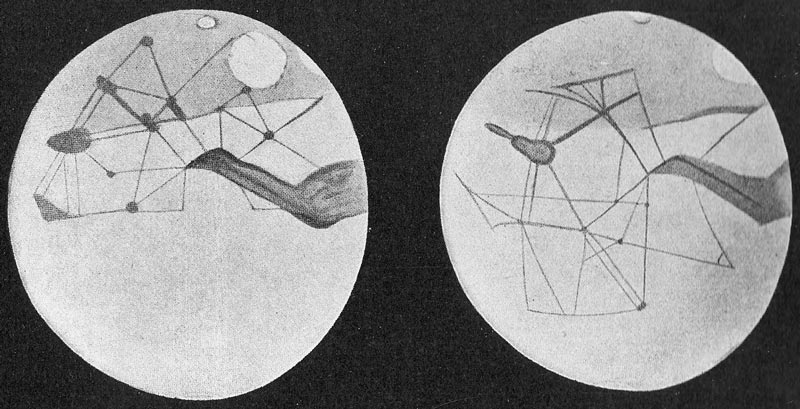
Percival Lowell was a contemporary of H.G. Wells.  Born in 1855, Lowell was a successful businessman who had an interest in astronomy.  This interest intensified when Lowell read Giovanni Schiaparelli published maps of Mars with channels across the surface in the 1890’s.  Schiaparelli was Italian, and the English version of his work translated the Italian word for channel -canalis – into canals.  As Mars headed towards opposition (closest approach to Earth) in 1894, Lowell set off to Arizona to make observations.  Perhaps with a strong preconception, or too much desire to make a groundbreaking discovery, Lowell published this drawing of Mars from his telescope.

Credit: Wiki Commons

Lowell speculated that intelligent life on Mars had built a series of canals to draw water from the polar ice caps to the mid-latitudes for irrigation.  Lowell’s work was rejected by other astronomers who also observed Mars during opposition but did not note canals.  Had Lowell been trained as a scientist, the lack of replication may had given him pause.  However, trained as a businessman, Lowell marketed his case directly to the public.  At first, through articles written for magazines such as the Atlantic Monthly, then through a series of books and continued defense of the canal theory until his death in 1916*.  Though rebuffed by astronomers, Lowell’s work on Mars provided a framework for popular culture during the next half century.

Against this backdrop, Wells published War of the Worlds four years after Lowell’s first observation of Mars.  Often lost in the subsequent radio and movie versions was Wells’ original intent to critique British colonialism, in particular, the concept of Social Darwinism.  This concept stated that various nations that are stronger are morally justified in the subjugation of weaker societies in a survival of the fittest competition for resources.  Wells’ point was, if that is the case, how could Britain complain if a stronger race colonized them?  In America, of course, it is the Orson Wells 1938 radio broadcast version of the story that is most well known.

The legendary broadcast was made so with media reports of panic induced by the realistic reporting of a Martian invasion.  However, the extent of the panic, if any existed at all, has been disputed.  From Wells’ work on, Martians became a cottage industry in both print and film.

And that cottage industry was all over the map.  From the classics such as Ray Bradbury’s The Martian Chronicles and Robert Heinlein’s Red Planet to horrendous efforts such as the movie Santa Claus Conquers the Martians, intelligent life from Mars was a staple in popular culture.  Remarkably, astronomers were publishing papers as late as the 1950’s that vegetation might exist on Mars.  Gerard Kuiper published a paper in the Astrophysical Journal during 1956 discussing the possibility of greenish moss (to be fair, Kuiper also postulated inorganic causes as well) on Mars during the spring/summer seasons.  William Sinton published an article in 1958 suggesting spectroscopic evidence of vegetation on Mars.  The concept of life on Mars would take a sobering turn in 1965.

Mariner 4 was launched on November 28, 1964 and begun its seven month journey to flyby Mars.  This mission would be the first to bring close up images of another planet back to Earth.  Prior to Mariner 4, astronomers had to rely on observatories which lacked digital CCD and adaptive optics technology available today.  Below are images of Mars taken from the 100-inch telescope at Mt. Wilson in 1956.

Credit: The Carnegie Institution for Science

What NASA got back from Mariner 4 in July, 1965 were images such as this:

Credit: NASA

The barren, cratered surface of Mars came as a disappointment.  Mariner 4 also measured a very thin atmosphere and lack of magnetic field.  As such, Mars does not have an ozone layer to protect organic compounds on the surface from ultraviolet radiation.  Without a magnetic field, the surface of Mars is also bombarded by a toxic stew of cosmic rays.  Quite simply, Mars is not capable of supporting life on a surface constantly exposed to harmful radiation from space.  However, future missions to Mars made it clear it is an interesting planet in an all together different way.  Much like the planet presented in The Martian.

In 1971, Mariner 9 became the first spacecraft to orbit a planet.  As a result, this mission was able to provide a comprehensive map of the Martian surface.  Imaging was delayed for two months by a massive dust storm, but once the imaging commenced, planetary scientists were delighted.  Among the findings were the largest canyon and volcanic features in the Solar System later named Valles Marineris and Olympic Mons.  Most importantly, Mariner 9 imaged ancient dry riverbeds and channels.  Water did once flow on the surface of Mars, albeit billions of years ago.  The success of Mariner 9 provided the impetus for Vikings 1 & 2, which landed on Mars in 1976 and gave us the first look at the surface.  This is how the landing was covered by ABC including an interview with Carl Sagan.

Viking searched for life on Mars and found none at the landing zones.  There was a 20 year lull in Mars exploration until 1997 when Pathfinder landed on Mars.  Tagging along for the ride was the Sojourner rover, the first of the Mars rovers, named after the 19th century abolitionist Sojourner Truth.  By 1997, the public had more access to NASA missions, specifically the mission website that provided updates and images.  The original website is still online and can be accessed here.

By this time, it was problematic to present a story with Martians that had serious social commentary a la War of the Worlds.  The notion of an advanced race on Mars could not be taken seriously and was reduced to efforts such as the 1996 comedy Mars Attacks.  During the course of the 20th century, the public perception of Mars went from a planet that might have an advanced race, to a planet that might have vegetation, to a planet that while geologically interesting, was devoid of life.  Conflict is the centerpiece of drama, and without the possibility of life on Mars, the traditional source of conflict had been removed.

Between Pathfinder landing on Mars in 1997 and its use as a plot device in 2015 in The Martian, there have been several orbiter, lander, and rover missions to Mars.  Mars Odyssey has been in orbit since 2001 and rover Opportunity has been exploring the surface since 2004.  NASA’s Mars Exploration website has images and video from all its active Mars missions.  Among the rover images are dust devils which were a feature of the landscape in The Martian.

The results of these missions were used quite effectively to provide a reasonably accurate take on what living on Mars would look like in the movie.  Without an alien race to provide drama, the central conflict is the harshness of space itself.  The challenges of human travel to Mars include limited availability of launch windows (once every 26 months as Mars approaches opposition), protection from cosmic rays, landing significant tonnage on Mars with very little atmosphere to provide braking, physical deterioration caused by Mars low (30% of Earth’s) gravity,  and utilizing recently discovered water resources below the surface.  The last point also underscores the need to determine if microbial life exists in the subsurface of Mars where water still exists.  Can we avoid contaminating Mars with microbial life from Earth and vise-versa?  NASA has an Office of Planetary Protection dedicated to that last issue.  Ironically, it was exposure to Earth’s microbes that did in the invading Martians to conclude H. G. Wells’ The War of the Worlds.

The Martian signifies that Hollywood has caught up with science in terms of presenting dramatic stories of Solar System exploration without intelligent life from Mars.  The other side of the human vs. harshness of space conflict is the fact that while we may send a handful of astronauts to Mars the next few decades, the vast majority of humanity will remain on Earth.  There will not be a mass migration to Mars if we foul things up on our home planet.  If space exploration can help discover a means to solve the challenges we face on Earth during the same time we go to Mars, it may be finding the right combination of international competition vs. international cooperation.  We can only hope that right mix may be found in reality as readily as it can be found in the movies.

*Percival Lowell’s true legacy to astronomy was founding the Lowell Observatory in Arizona where Pluto was discovered.  In 2015, its 4.3 meter telescope became fully operational.  You can check that out on the Lowell Observatory website.

**Image on top of post is Mars Pathfinder landing site in 1997, to be visited by Mark Watney in the future.  Credit:  NASA/JPL