Where Apollo Landed on the Moon

During the Apollo era, I remember gazing at the Moon to find the areas where astronauts were exploring at the time.  Even with the most powerful telescopes, we are unable to detect the flags and equipment left behind, but it still is an interesting challenge to pick out these spots and not a bad way to learn about the Moon as well.  Recently, the Lunar Reconnaissance Orbiter has been able to image these landing spots and made some discoveries that point to some other interesting potential landing regions should we return.
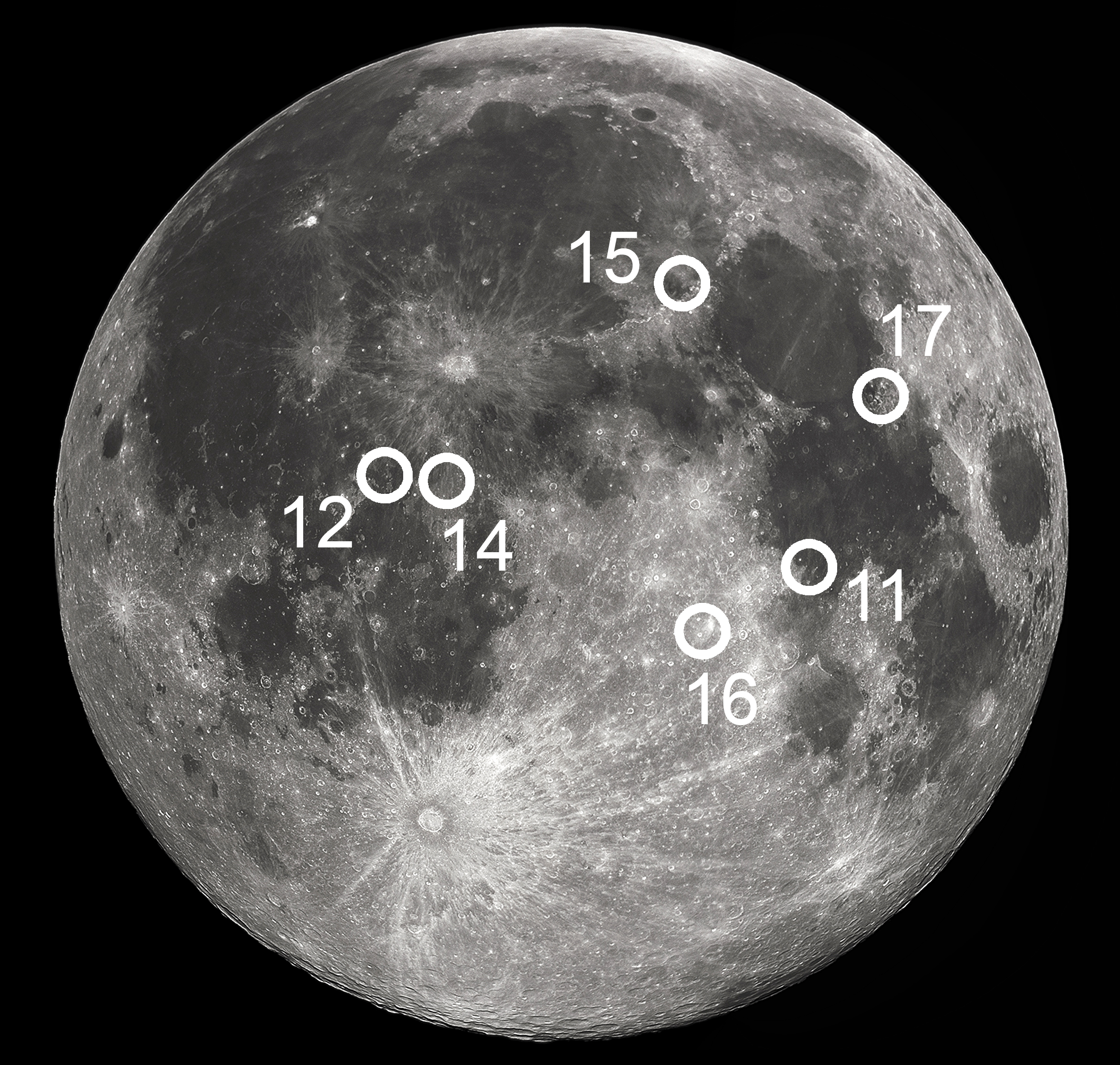
Apollo landing sites. Credit: Soerfm/Wiki Commons

The Moon is divided into two types of terrain, the highlands which are the bright regions and the maria which are the darker areas.  The highlands are very old, about 4-4.5 billion years and thus, heavily cratered.  This makes the highlands geologically rich but challenging to land on.  The maria are younger and thus easier to make a landing attempt as the terrain is smoother.  The maria were formed 3-3.5 billion years ago when large impacts flooded basins with lava eventually to solidify into the dark, iron rich basaltic surfaces we see today.  Maria is derived from the Latin word for seas which ancient astronomers thought these dark areas were.  Of course, there are no large bodies water to be found in the maria.  Like the first Apollo landings, a return to the Moon will likely begin in the maria and expand outward into more challenging landing zones.

Apollo 11

Neil Armstrong and Buzz Aldrin spent 21.5 hours on the lunar surface on the Sea of Tranquility.  Just before the famous Christmas Eve reading of Genesis by the Apollo 8 crew, William Anders noted the Sea of Tranquility was selected as a future landing site in order to preclude dodging mountains.  While there were not any mountains to dodge, there were several large boulders causing Neil Armstrong to take manual control of the lunar module, eventually finding a safe landing spot with 25 seconds of fuel to spare.  Apollo 11 returned 22 kg (48 lbs) of samples back to Earth.  As would be expected from landing in a mare region, the rocks were mostly basalt created from lava when the region formed.  There were also breccias which are smaller fragmented rocks fused together over time.

Apollo 11 landing site from 15 miles above the lunar surface. The foot trail to the crater right center is 50 m (164 ft) and was furthest Armstrong and Aldrin ventured from the lunar module. Credit: NASA.

Apollo 12

Launched during a rainstorm, the crew of Apollo 12 had to experience the adventure of getting hit by lightning before reaching orbit and proceeding to the Moon.  Like Apollo 11, this mission landed in a mare region.  The Ocean of Storms (or Oceanus Procellarum in Latin) was the landing site of Surveyor 3 in 1967.  NASA wanted to aim for a precise landing near Surveyor 3 and examine samples in this region which appeared younger than the Sea of Tranquility.  Astronauts Pete Conrad and Alan Bean made two excursions on the lunar surface reaching half a mile away from the lunar module.  The samples were mostly basalt and, as expected, were 500 million years younger than the Sea of Tranquility establishing a range for lunar volcanic activity.  The crew also visited the Surveyor 3 and retrieved its television camera which is currently on display at the Smithsonian Air & Space Museum.

Pete Conrad checks out Surveyor 3 with lunar module 600 feet away in the background. Credit: NASA.

Apollo 14

After the Apollo 13 landing was aborted due to an explosion in a service module oxygen tank, its intended landing site in the Fra Mauro formation was slated for the Apollo 14 mission.  This was the first landing to occur in the lunar highlands.  This region contains rocks ejected by the formation of the Imbrium basin and it was hoped to capture samples that originated deep under the lunar surface.  The plan was also to capture samples from the nearby Cone Crater but the rugged terrain prevented the astronauts from reaching the rim.  Alan Shepard and Edgar Mitchell collected almost 42 kg (92 lbs) of rock samples most of which were breccia formed by rocks fragmented by the impact event.  The crew did collect some basalts which clocked in at 4-4.3 billion years old, significantly older than the earlier basalts collected.  Apollo 14 also had perhaps the most humorous event of the program with Alan Shepard’s attempt to play golf on the Moon.

Apollo 15

Hadley Rille from space with circle denoting Apollo 15 landing site. Credit: NASA

Apollo 15 began the J-series missions for the program.  These missions were more ambitious with longer duration stays and with the lunar rover, the ability to travel longer distances from the lunar module.  Apollo 15 was the first landing to stray away from the equatorial region.  David Scott and James Irwin spent some 18 hours exploring the lunar surface and traveled 28 km (17 miles-compared to 2 miles on foot for Apollo 14) on the rover.  A major target was the Hadley Rille.  Rilles are sinuous features on the Moon thought to be ancient lava tubes whose ceilings have since collapsed.  Indeed, the rocks returned from this region were basaltic in nature.  By the time Apollo 15 landed on the Moon, the final three missions (Apollo 18-20) were cancelled due to budget cuts, meaning there were only two trips to the Moon left for the program.

The 300 meter (1,000 feet) deep Hadley Rille from the lunar surface. Credit: NASA.

Apollo 16

This mission was specifically designed to bring back samples from the highlands.  Landing in the Descartes formation, Apollo 16 would return 96 kg (211 lbs) of Moon rocks that would fundamentally alter our understanding of the highlands.  Previously thought to be of volcanic nature, the sample contained very few basalt rocks.  Instead, the samples were breccia in nature.  Rocks on the Moon are fragmented when impacts occur.  These fragmented rocks are then fused together to form breccia rocks by the heat caused by subsequent impacts.  The age of the highland are 4.5 billion years old.  This dates back to the origin of the Moon as it cooled from a molten to a solid state.

Charlie Duke takes a sample of permanently shadowed soil next to the large boulder named, appropriately enough, Shadow Rock. Credit: NASA

Apollo 17

As this was the final Apollo mission, a sense of urgency was placed on obtaining a high scientific yield.  At one point, a landing on the far side was considered but rejected as it would require the additional cost of a communication satellite.  The far side is often confused as the dark side of the Moon.  However, during the new Moon phase the far side is facing the Sun and experiences daylight.  The far side differs from the near side as it is mostly highlands and has very little maria regions as can be seen below.

Credit: NASA/Goddard/Arizona State University

The site selected was Taurus-Littrow Valley, a very geologically diverse region that required a precision landing.  For this mission, Harrison Schmitt was moved up from the cancelled Apollo 18 mission to become the first astronaut-scientist.  Three days after the only night launch of the Apollo program, America made its final Moon landing.  Three excursions extending 25 km (15 miles) brought back a haul of 111 kg (245 lbs) of samples including highland rocks ranging from 4.2-4.5 billion years old, basaltic rocks from the valley floor indicating volcanic activity about 3.7 billion years ago, and ejecta from the Tycho crater that was 100 million years old.  By lunar standards, the Tycho crater is a relatively young feature even though dinosaurs were walking on Earth when created.

Apollo 17 lunar rover at the edge of Shorty Crater. Near the rim there is orange soil that is titanium rich pyroclastic glass originated from 10 meters below the surface but was ejected during the impact event. Credit: NASA.

Lunar Interlude

The scientific phase of the Apollo program, which was to be 18-20, was cancelled by President Nixon as the economy began to experience its first bout of both high inflation and unemployment that would plagued the economy during the 1970’s.  Two of the unused Saturn V’s are on display at the Kennedy and Johnson Space Centers.  NASA began to develop the space shuttle and its planetary exploration program.  The public lost interest in lunar exploration as there was a sense of been there, done that.  However, the lunar surface covers an area 38 million square km (14.6 million square miles), about four times the surface area of the United States.  As NASA began to recommence unmanned lunar exploration in the 1990’s, the Moon began to offer some surprises.

Lunar exploration was started again in 1994 with the Clementine mission that globally mapped the Moon, in particular, the 15 km (9 mile) deep South Pole-Aitken Basin.  This was followed by the Lunar Prospector in 1998.  The Moon had been thought to be completely water free but the Lunar Prospector detected the presence of 300 million tons of water mixed in the soil at both polar regions.  How could water exist on the Moon?  The Moon’s axis is only tilted 1.5 degrees.  This means the Sun in these regions can only reach 1.5 degrees above the horizon, roughly the same as the Sun about ten minutes after sunrise in the mid-latitudes on Earth.  Hence, large craters remain in permanent shadow so that any water there will not evaporate into space.

Blue indicates regions on Moon where water may exist. Credit: NASA.

However, the Lunar Reconnaissance Orbiter (LRO), launched in 2009, discovered the presence of hydrogen beyond shadowed areas of the Moon.  The water could have been delivered to the Moon very early in its history via comets.  It is also thought the solar wind, which carries hydrogen, could interact with oxygen embedded in silicates on the surface to form water.  To be sure, we’re not talking lakes or even underground springs here.  The water amounts to about 45 parts per million, but given the cost to lift material from Earth into space (about $10,000 per ounce), any long-term settlement on the Moon will require the use of raw material situated there.  This gives some promise that the Moon could be used as a base to colonize space.

Above – LRO’s high-resolution tour of the Moon

NASA is currently developing the Orion crew module along with the heavy lift Space Launch System which will make an unmanned test run past the Moon in 2018.  The ultimate goal of this program is to land humans on Mars although a lunar program to test mission systems beforehand is not out of the question.  Going to the Moon is only a three-day hop compared to seven months for Mars.  Using the Moon as a testbed could make sense before making the leap to Mars.  It is often argued that unmanned missions are less expensive, and less hazardous than crewed spaceflight.  However, humanity is hardwired to explore and expand its presence.  That is how we expanded beyond our origins on the African continent across the oceans to all corners of the Earth.  Hopefully, in the near future, children will once again gaze at the Moon and ponder the about the people exploring our nearest celestial neighbor.

The Education of Albert Einstein

Most historic figures have myths attached to them and certainly Albert Einstein is no exception.  Among them, Einstein failed math in high school and did his famous work on relativity in “splendid isolation”.  After reading Walter Isaacson’s biography on Einstein, one can see the social influences that shaped Einstein in his early years and how it enabled him to make advances in physics that others could not.  And much of that is rooted in modern educational theory.

Jean Piaget’s research on child development concluded there are four stages of development.  The final transition usually occurs around age eleven when a child moves from a concrete understanding of the world to an ability to solve abstract and hypothetical problems.  The age this transition occurs can vary with each individual and also with the subject matter.  Contrary to the struggling student myth, Einstein began thinking in abstract terms at a very early age.  A compass given to Einstein at age five demonstrates this.  Rather than thinking of the compass in concrete terms, that is, a mechanical device that points north, Einstein conjectured on the invisible magnetic field that caused the compass to always point north.  And this trend continued in Einstein’s early life.

During the 1930’s, a Ripley’s Believe It or Not! column stated Einstein failed math in high school and has remained part of the Einstein lore.  Truth is, Einstein had learned calculus by age 15.  And physics?  Einstein was at a college level by age 11.  How did this myth begin?  More than likely from Einstein’s days as a student in Germany’s authoritarian educational system.  Einstein thought little of rote learning, and was not afraid to make his teachers aware of that.  In today’s parlance, that bit of acting out probably gave the impression of a troubled student.  So what was it in Einstein’s background that allowed him to advance so quickly in his studies?

The second pillar of modern educational theory is Lev Vygotsky’s theory of learning by social interaction.  Part of that theory is the concept of the zone of proximal development.  Here, a student is placed in contact with a more skilled partner to help master a subject.  In Einstein’s case, his parents provided the first zone of proximal development.  Hermann Einstein, Albert’s father, partnered with his brother Jakob building electric generators and lighting.  This surrounded Albert with a technical/scientific background from the get-go not unlike, say, Bill Belichick growing up in a household with a football coach as a father.  Pauline, Albert’s mother, was a pianist and Albert would play the violin most of his life to catch a break from physics.

Einstein plays the violin during the charity concert in the New Synagogue, Berlin, January 29, 1930. Credit: Institute of Czech Literature, Czech Academy of Science.

At age 10, Einstein was introduced into another zone of proximal development in the person of Max Talmud, a 21-year-old medical student who had dinner with the Einsteins weekly.  Talmud introduced Einstein to many subjects including geometry and Kant’s Critique of Pure ReasonTalmud’s greatest gift to Einstein may have been Aaron Bernstein’s 21 volume People’s Book on Natural ScienceBernstein encouraged constructive learning techniques, in particular, thought experiments such as what it would be like to ride along a light beam.  These thought experiments played a crucial role in Einstein’s relativity breakthroughs and his attempt to describe the theory to the public in his book, Relativity:  The Special and General Theory.

As one might imagine, Einstein raced out of Talmud’s zone of proximal development in short order.  Not unlike the first time a student realizes they have raced ahead intellectually of their teacher.  Nonetheless, Talmud served as a rich pipeline of learning resources for Einstein.  In some sense, Talmud was Einstein’s version of the internet without all the negative distractions.  This resource enabled Einstein to think in ways that provided insights to solve problems other physicists were not able to.  Young Albert Einstein also possessed a fierce streak of individuality.

Self-identity is typically formed during high school years, but can be delayed beyond college.  By all indications, Einstein’s self-identity was molded by his family and his ethnicity.  Of the four general parenting characteristics, the Einsteins would fall into authoritative (not to be confused with authoritarian).  This engaged parenting style typically endows a child with high self-esteem and confidence, which certainly Albert Einstein possessed.  As a Jew in Germany, Einstein was an outsider in German society (as Isaacson notes, only 2% of Munich’s population was Jewish) and this reinforced Einstein’s contempt for the German authoritative educational system.  The Swiss educational system was another story.

Aarau, Switzerland. Credit: Roland Zumbuhl/Wiki Commons

Fed up with Germany, Einstein moved to Switzerland at age 16 and spent a year at the Aarau Cantonal School.  This school favored a constructionist educational philosophy where students build their own knowledge rather than simply accepting what was told to them by an authority figure.  Part of the instructional technique at Aarau included an emphasis on visualization of mathematical concepts based on the ideas of Johann Heinrich Pestalozzi who also valued student individuality.  Einstein thrived at Aarau and its visualization techniques played a significant role in Einstein’s breakthroughs in relativity.

Einstein’s Aarau transcript. Grade scale is 1-6 with 6 being best grade. Credit: Wiki Commons. Translation can be found at: https://commons.wikimedia.org/wiki/File:Albert_Einstein%27s_exam_of_maturity_grades_(color2).jpg

However, Einstein’s professional academic career did get off to a slow start.  In fact, he was working at a Swiss patent office in 1905 when he published four landmark papers on special relativity, mass-energy equivalence (E = mc2) the photoelectric effect (proving light acts as particles as well as waves) and Brownian motion (which established the existence of atoms).  Einstein’s anti-authoritarianism during his college years at Zurich Polytechnic rubbed some of his professors the wrong way and he had difficulty obtaining good references.  This has led to the myth of Einstein working in “splendid isolation” during this time.  And in a sense, Einstein was isolated from the heavy hitters in physics.  However, this may have been a godsend as those heavy hitters made discoveries that pointed towards relativity, but lacked the creativity Einstein possessed to put all the pieces together.  In pursuit of this, Einstein found one more learning social component in Zurich.

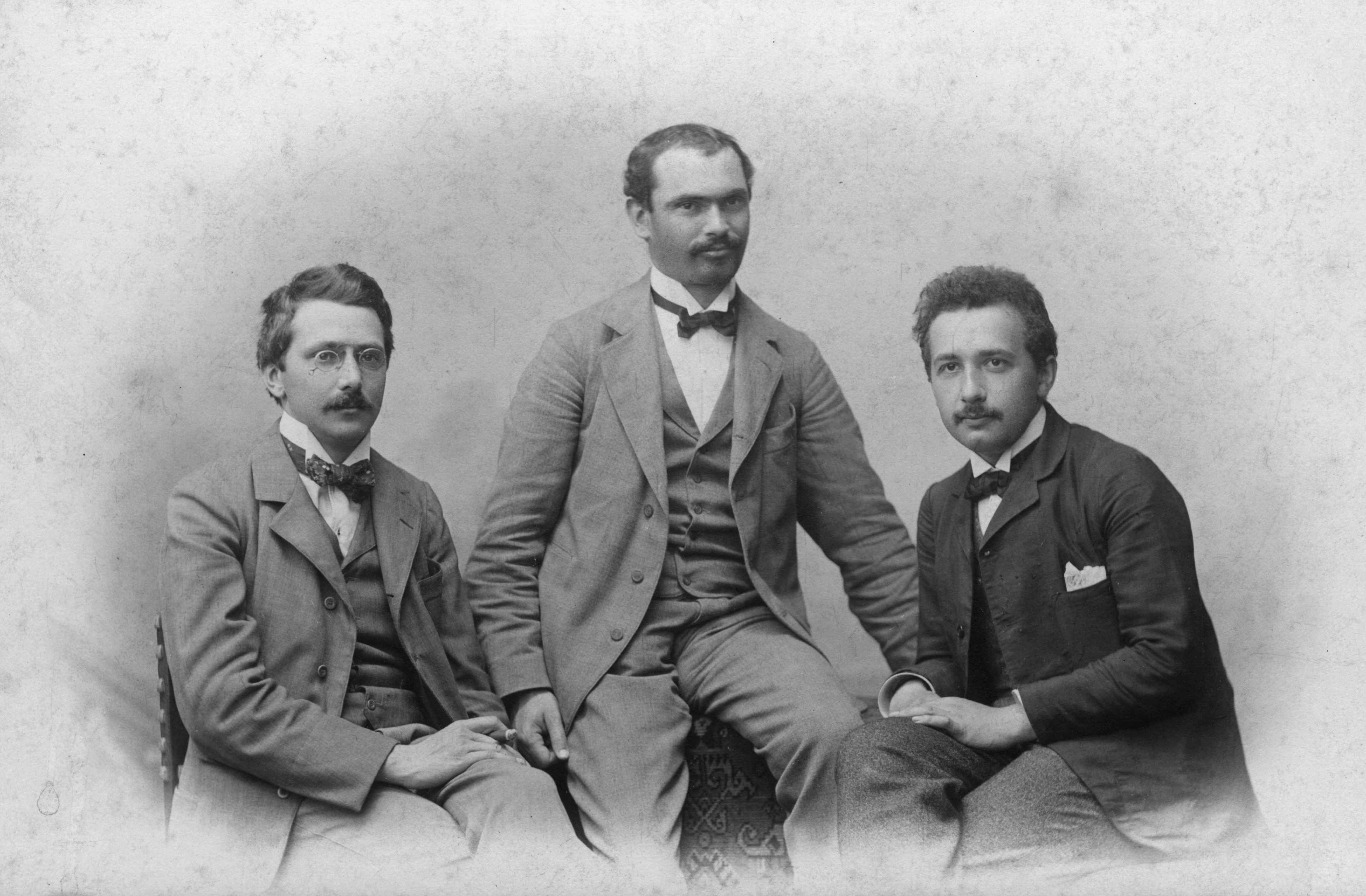
The Olympia Academy founders Conrad Habicht, Maurice Solovine, and Albert Einstein. Credit: Wiki Commons/Emil Vollenweider und Sohn

Had Einstein been discussing the current problems of physics in academia after the turn of the century, he would have been hamstrung by the Newtonian concept of absolute time.  That is, clocks run at the same pace for every observer in the universe.  Einstein and a group of friends formed what they jokingly dubbed the Olympia Academy.  Of the many topics discussed during these weekly sessions were David Hume’s and Ernst Mach’s rejection of absolute time.  This skepticism of Newtonian absolute time is the linchpin of special relativity, which states the speed of light is constant to all observers in the universe and time is variable as a function of velocity (times moves more slowly the faster you go, reaching a standstill at the speed of light).  Special relativity also put the universal speed limit at light speed leading to general relativity, which redefined gravity as curvatures in space-time which ripple throughout the universe at the speed of light and not instantaneously via Newton’s gravitational fields.

So is there anything we can apply from Einstein’s education?

To begin, don’t expect your students to become Einstein – the human race is lucky to experience such a genius once a century.  Great disasters are usually the result of many little things going wrong, great successes require many little things going right.  Replicating Einstein’s education will not likely produce another Einstein anymore than putting a hockey stick in a child’s hand will make him a Wayne Gretzky.  But to continue the sport’s analogy, Red Auerbach expressed a coaching philosophy that his job was to help his players reach their differing levels of maximum potential.  To illustrate, I am the same height as Larry Bird and Magic Johnson, but my maximum potential as a basketball player is significantly lower.  Rather than concern myself with that, with proper instruction, I should focus on reaching my personal potential level.

For example, if a student is struggling putting the ball in the hoop, rather than give a wedgie George Costanza style, have the player perform a thought experiment Albert Einstein style.  Instead of traveling with a light beam, imagine moving along with a basketball headed for the rim.  Take two scenarios, a shot with a low arc and one with a high arc.  How does the hoop appear as you are headed with the ball towards it?  The ball with the high arc “sees” more area in the hoop to enter, increasing the odds of making two points.  It  might not make the child into Larry Bird, but will move forward into reaching their full basketball potential wherever that may fall.

Techniques such as this allows a student to internally construct knowledge and not simply take a teacher’s word for it.  And student’s can apply these techniques in other subjects.  Also, the social component of learning cannot be ignored.  Ridiculing, instead of providing instruction, for a poor performing student causes social isolation not only in that class, but can cascade throughout the educational experience.  All the educational resources in the world cannot help a student who is socially isolated.  And likewise, lack of community resources in the educational system can thwart good instruction.  Teaching someone to fish may keep them well fed, but it only works if they actually have a fishing rod to use.

To maximize a student’s potential a rich social experience is required where ideas are passed back and forth as well as contact with more experienced learners.  This does not stop after childhood.  As the great economist Alfred Marshall noted, inexperienced workers are more productive when teamed with more experienced workers.  This is also why industries tend to form geographic clusters such as Silicon Valley.  In fact, despite his disdain for Germany, Einstein moved to Berlin in 1914 as that was the center of physics on the continent.  The diaspora of Jewish scientists, including Einstein, in the 1930’s had the opposite effect of diminishing Germany’s physics research.  Also, adequate resources must be available to apply what is learned.  Can a student without computer resources expect to function well in today’s society?  Finally, do not burden the student with unrealistic expectations.  Focus on what the student can do, not what they cannot do, and use that as a base to build upon to reach their own level of maximum potential.

*Image on top of post is Einstein presenting a lecture at American Association for the Advancement of Science in Pittsburgh on December 28, 1934.  Credit:  AP/Public Domain.

Why Go to Jupiter?

At 11:53 P.M. EDT on July 4th, as the last of the fireworks begin to fade, NASA will be eagerly awaiting a signal from the Juno spacecraft that it has entered orbit around Jupiter.  This will commence twenty months of exploration of Jupiter’s polar regions which is the epicenter of the giant planet’s massive magnetic and auroral activity.  It will also signify the beginning of the end of NASA’s second wave of space missions to the gas giants that began in 1989 with the launch of the Jovian Galileo probe.  In September 2017, Cassini will cease operations with a decent into Saturn.  Five months later, Juno will meet the same fate as it plunges into Jupiter.  NASA’s exploration of the outer planets will go dark until the 2020’s.

Juno, named after the Roman goddess wife of Jupiter, was launched in 2011 and embarked on a 1.8 billion mile odyssey to the giant planet that included a flyby past Earth.  Why flyby Earth?  The pull of Earth’s gravity whipped Juno into sufficient velocity to reach Jupiter.  This maneuver, while more time-consuming, saves fuel and cost.  Not an insignificant consideration as Juno was hatched during an era of flatline budgets for NASA.  In all, the Juno mission will cost $1.1 billion or roughly the same as a NFL stadium.  Below is a video of Juno’s trajectory to Jupiter.

Normally, we associate planetary missions with spectacular imagery.  Juno does have a camera on board but that will be used for outreach purposes.  The science of Juno involves magnetometers and particle detectors.  Jupiter has a massive magnetic field that produces aurora activity several times the size of Earth and radio emissions as well.  Juno intends to use its measurements to study the interior of Jupiter which in turn will reveal the processes that drive its magnetic activity and origins.

Jupiter’s aurora was discovered in 1979 by Voyager I.  On Earth, the aurora is created by ionized particles embedded in the solar wind spiraling down Earth’s magnetic field lines towards the poles (charged particles will follow the path of magnetic fields).  Here, in the upper atmosphere, the ionized particles slam into oxygen and nitrogen atoms exciting their electrons to a higher energy level.  As the electrons subside back to a lower energy level, the kinetic energy of these particles are converted to electromagnetic energy in the form of green and red light.

Juno’s elliptical orbits will avoid zones of high radiation surrounding Jupiter. Credit: NASA/JPL/Caltech/Institute for Aeronautics and Astronautics

On Jupiter, the process is a bit different.  The solar wind contributes to the aurora, but there is another major source of ions from the moon Io.  The most volcanic active body in the Solar System, Io spews out oxygen and sulfur ions that travel along Jupiter’s magnetic field to the poles.  The aurora has been viewed by the Hubble which recently released this image.

aurora
Credit: NASA/ESA

When electrons are accelerated, radio waves are transmitted.  This is the principal that radio towers work on.  Electrons are accelerated up and down the transmission tower producing the broadcast received by your radio and converted to sound waves by its speakers.  Around Jupiter, electrons are accelerated as they spiral down the magnetic field lines.  Io also acts to accelerate electrons as its presence distorts Jupiter’s magnetic field. A change in a magnetic field induces an electric field pushing the electrons.  This action creates radio transmissions from Jupiter that are received on Earth in the 8-38 MHz range, the same range shortwave radio is transmitted.

Ham radio operators have received these transmissions from Jupiter and NASA’s Radio Jove project allows schools to purchase receivers for a few hundred dollars to detect Jupiter’s radio waves.    Samples of these radio observations can be heard here.

One might ask, why should we care about Jupiter’s magnetic field and how does it relate to Earth?  The answer lies in the fact that while we can map Earth’s magnetic field as it extends into space, we are unable to map the dynamo process generating the field in Earth’s interior.  Jupiter, being a gaseous planet, will allow Juno to map the magnetic field down to the interior where the dynamo lies.  Jupiter formed before the solar wind blasted away the primordial material of the solar nebula.  The more we learn about Jupiter’s interior, the more we’ll know how the Solar System originated.  The video below describes how Juno will explore Jupiter’s magnetic field.

Juno’s instrument package includes a radio transmitter to detect variations in Juno’s velocity as it orbits Jupiter.  Doppler shifts in the radio waves will allow for measurements of variations in Jupiter’s gravity field providing hints to the make up of its interior.  The Jovian Auroral Distributions Experiment (JADE) and Jupiter Energetic Particle Detector Instrument (JEDI-video below) will measure the ions and electrons traveling along the magnetic field lines that eventually produce Jupiter’s aurora.

The Jovian Infrared Auroral Mapper (JIRAM) will provide images of Jupiter’s aurora.  Juno’s magnetometer will construct a 3-D map of Jupiter’s magnetic field, both the field lines and their magnitude.  The Microwave Radiometer’s (MWR) function is to detect thermal radio emissions from six layers beneath the clouds of Jupiter.  This will provide a 3-D map of the Jovian atmosphere.  The Ultraviolet Imaging Spectrometer’s (UVS) mission is to examine the aurora in ultraviolet allowing for measurements on both the day and night sides of Jupiter.  The aptly named Waves instrument will measure radio waves produced by the magnetic field.  Last, but not least, is the JunoCam which will take the first pictures of Jupiter’s poles and allow for the public to participate on deciding other targets to image.

Image of Antarctica taken by JunoCam during Earth flyby. Credit: NASA.

On February 21, 2018, after completing 37 elliptical orbits of Jupiter, Juno will crash into Jupiter ending its adventure.  The next mission to the outer Solar System is not scheduled until the 2020’s with NASA’s planned Europa mission.  This gap was caused by funding curtailments created by the Great Recession.  This is similar to the gap between the Pioneer and Voyager missions launched in the 1970’s and the Galileo mission launched in 1989.  That first gap was caused by budget cuts during the Reagan administration in the 1981-82 recession. In fact, that gap almost became catastrophic as the administration proposed to terminate Voyager funding before the mission reached Uranus and Neptune.  Fortunately, Voyager was kept alive and is still returning data today.  So, what can we hope for in the meantime?

The Hubble Space Telescope will still take high quality images of the outer planets, and will be joined by the James Webb Space Telescope in 2018.  Of course, both have other mission objectives and are not dedicated to viewing the Solar System.  The next generation of ground telescopes featuring mirrors in the 30-40 meter range will be able to peer deeper with more detail into the Solar System, possibly mapping surface characteristics of Kuiper Belt objects.  New Horizons just received funding approval to visit the Kuiper Belt object 2014 MU69 beyond Pluto on New Year’s Day in 2019.  Despite the upcoming lull in deep space exploration, the future still looks interesting for planetary science.

*Image on top is workers testing the solar panel for Juno prior to launch.  Credit:  NASA.